
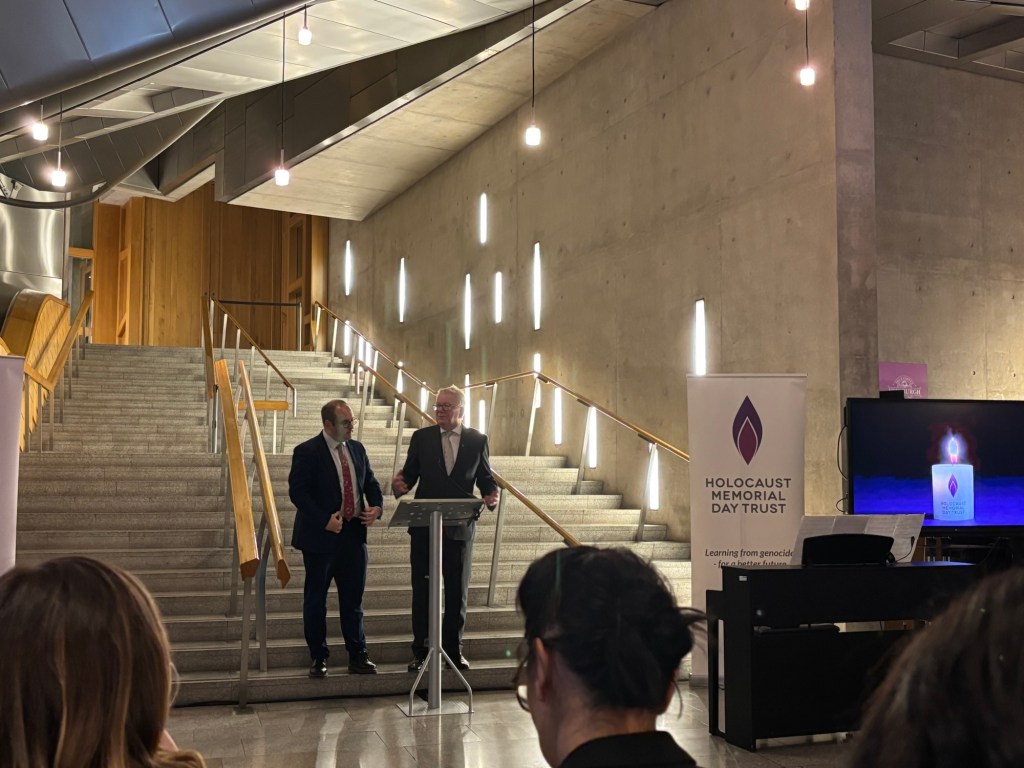
The year 2025 marks both the 80th anniversary of the liberation of Auschwitz, and the 30th anniversary of the genocide at Srebrenica. Separated by half a century, the events in Bosnia remind us that ‘never again’ did happen again. So what do we do about this? I write this piece whilst returning home from an event at the Scottish parliament that tried to address that incredibly difficult question. Here are five major takeaways that I hope will give you much to reflect, and act, upon.
Takeaway #1 Making survivor testimony part of your story
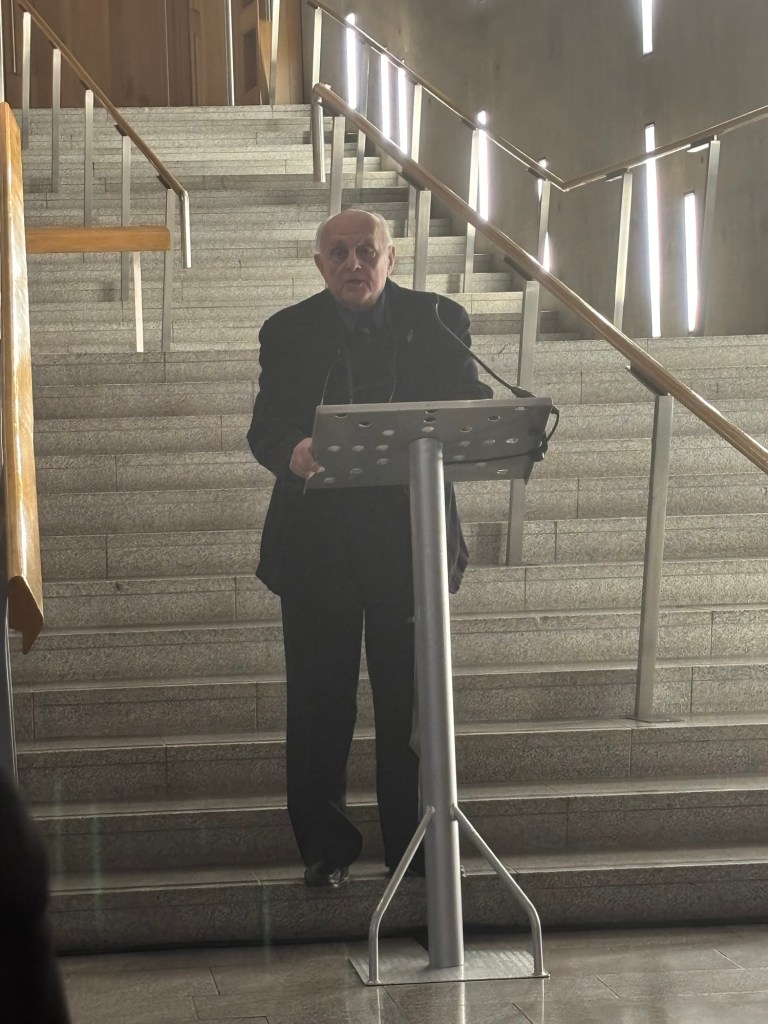
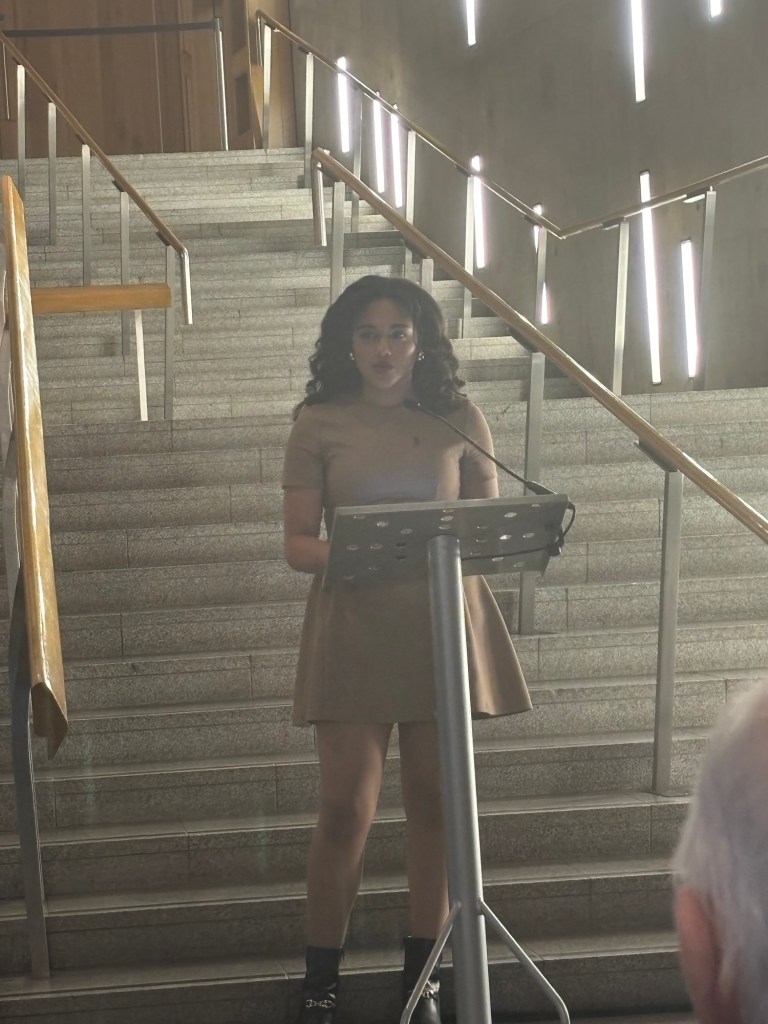
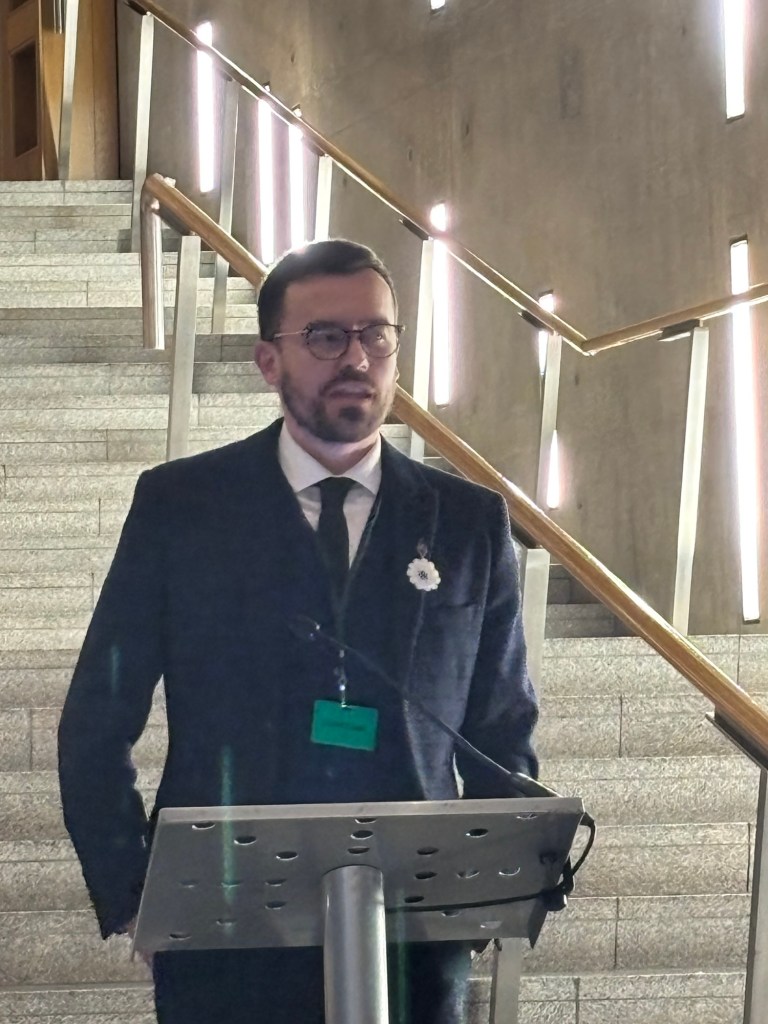
One of the most significant aspects of this commemoration is that it covers the Holocaust and also subsequent genocides. We hear from Dr Alfred Garwood, who as a child survived Bergen Belsen, and we also hear from Smajo Bešo OBE, who survived the Bosnian genocide. We hear an original piece of poetry from Kaela-Kaliza Molina about the Rwandan genocide called “We all bleed the same”, and a reading from the Life of Chaya Stokja, by Romano Lav, which focuses our attention on the Roma and Sinti communities. This is a fully inclusive event which gives us pause to reflect on the nature of genocide across many conflicts, which consequently has an even greater impact on the audience.
There are so many powerful reflections which speak both to the inhumane suffering caused by genocide, and also the inspirational humanity of the survivors. Alfred Garwood shares, in a quiet voice, that “as a child in the Holocaust you had to learn certain lessons. Children who cried, died.” His traumatic childhood experiences led him to be surrounded by hatred, not just in eastern Europe but also in London, but he tells us that “hate didn’t hurt the person who was hated, it hurt the person who was hating.” His experiences taught him, as a child who experienced trauma, to lead a life that was “watchful and silent”, but also one that was driven by a desire to be a “healer of human wounds.” He became a psychiatrist, a psycho-analyst, and a specialist in childhood trauma, working with fellow children of the Holocaust. Dr Garwood (who changed his name as a Polish refugee so he could enter a UK medical school) is a reminder that the generation who survived the Holocaust are the witnesses to history, and we owe it to them not just to listen, but to change the future as a result of their past.
Smajo Bešo starts his story of the Bosnian war by telling us that he and his family moved fourteen times in the first nine months, just to survive. They found themselves in Mostar, where “if bombs and bullets didn’t kill you, disease and starvation would.” The death of his beloved Aunt Amina caused him to lose his faith in humanity, but his mother sat him down and explained that they could not live their lives by hate. People can choose how they react to any situation in life, and no one can take that away from them. Rejecting hatred is a conscious choice. Smajo notes that Bosnia didn’t have a Truth and Reconciliation Commission like South Africa, so he has launched his own. “Peace is very personal. It is more than the absence of war. Only by taking action can we build a better world for us all.” He implores us to take the stories of victims and survivors and to make them part of our story too. That isn’t easy, but it is essential.
Takeaway #2 Pupil voice amplifies the voices of the victims
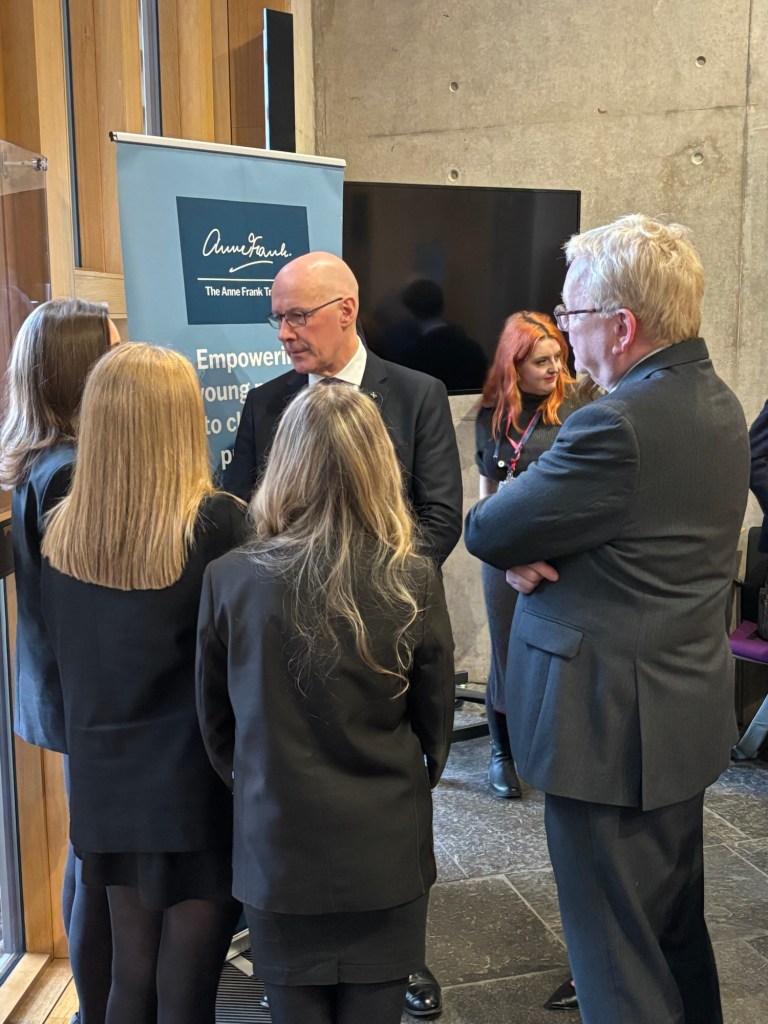
If Smajo has challenged us to take forward the stories of those who have suffered as a result of genocide, the school pupils in attendance today have taken up the baton. We hear from three ambassadors of the Anne Frank Trust from Mearns Castle High School. Lexie, Anna and Sam, who between them have visited Anne Frank House in Amsterdam and Auschwitz, speak with both an incredible balance of passion and compassion. There is striking maturity in what they say, as they tell us how they have spread awareness in their own communities.
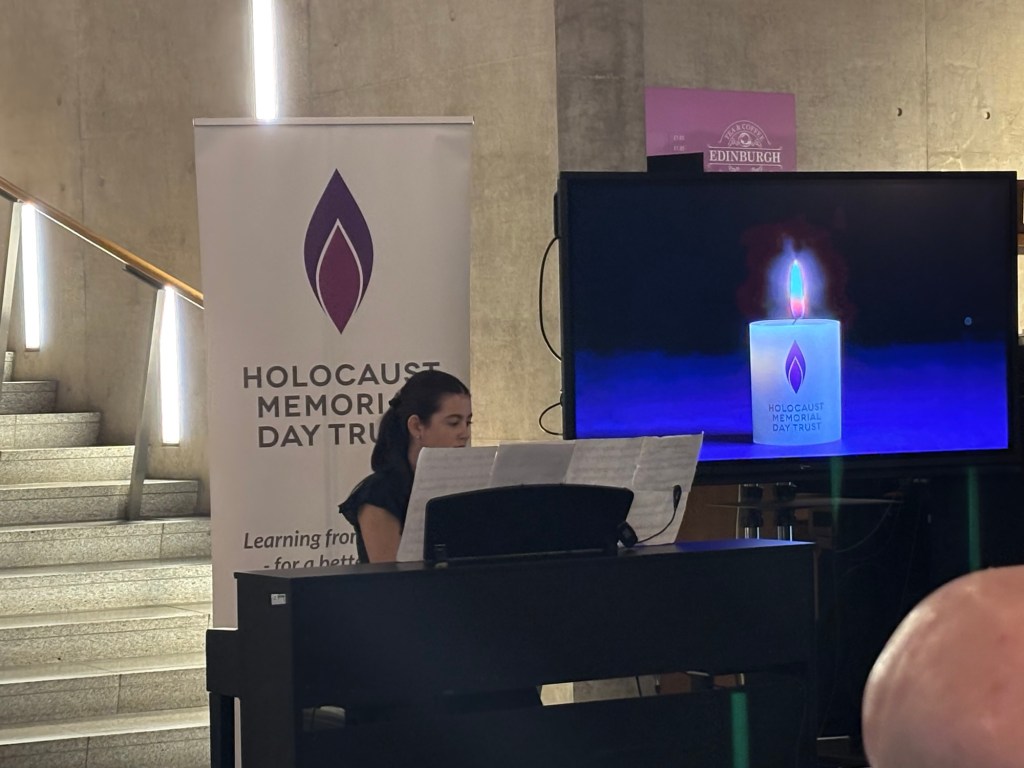
We hear from David and Eva from Largs Academy, who are ambassadors for the Holocaust Education Trust. The efforts they have gone to in order to share their learning from their visit to Auschwitz are impressive. Their composure and their commitment are inspirational. We have some time for reflection as Petra, from Aberdeen School of Music, gives a stunningly beautiful rendition of Adagio in G by Albinoni. Elsa and Olive, who are primary pupils and the daughters of a survivor, read the Srebrenica prayer in Bosnian and English:
We pray to almighty God,
May grievance become hope
May revenge become justice
May mothers’ tears become prayers
That Srebrenica never happens again
To no one, no where
The room is full of some of Scotland’s most important political leaders, including the First Minister and the Presiding Officer. The combined effect that survivor testimony and reflections of the new generation has is something that I can’t properly convey, other than to say that it is extremely powerful.
Takeaway #3 The whole is greater than the sum of the parts
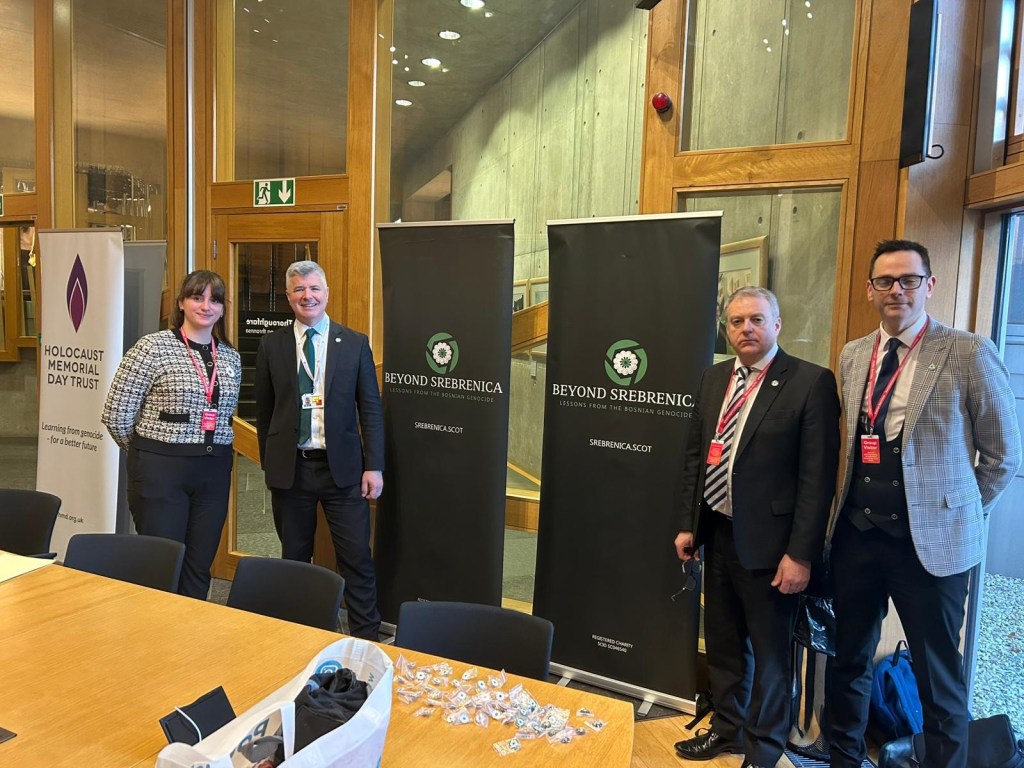
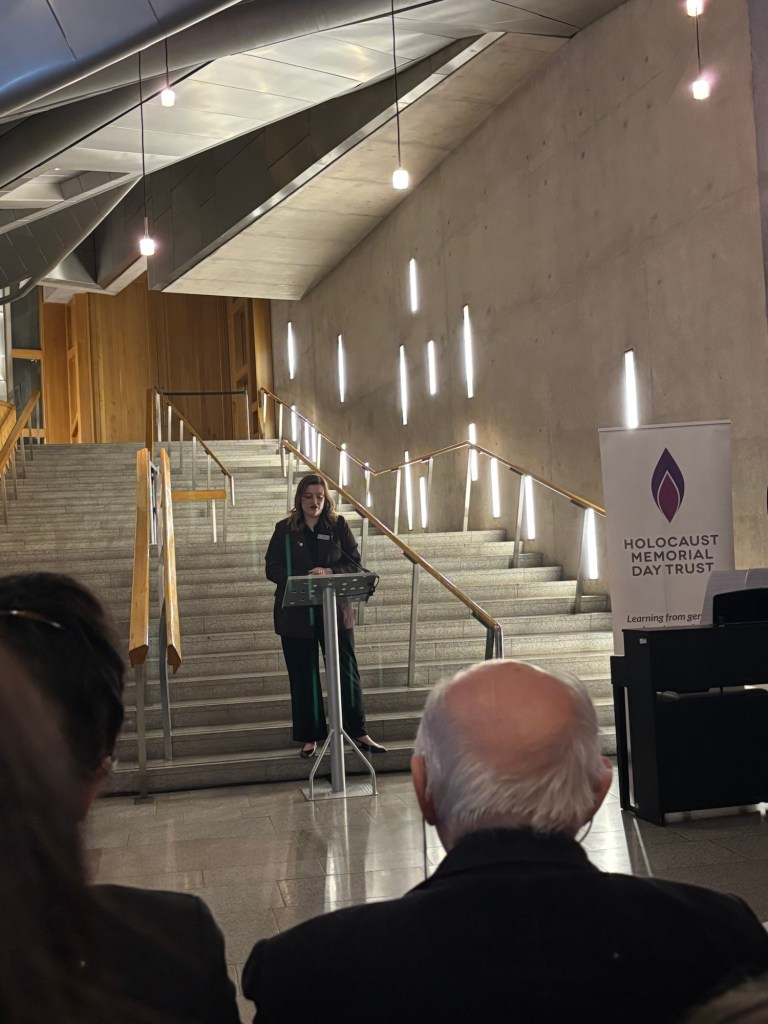
Although this event was organised and led by the Holocaust Memorial Day Trust (HMDT), it was a collaboration with four other education charities. Kirsty Robson of the HMDT is an absolute star, working tirelessly to make this event a success, and she deserves much credit for bringing together HMDT with the Anne Frank Trust, the Holocaust Education Trust, Vision Schools Scotland, and Beyond Srebrenica (of which I am a trustee). Kirsty also pays a moving tribute to Holocaust survivor Henry Wuga MBE, who passed away last year. We have learned so much from one another in the process of co-creating this event, and many good things will come from the collaboration.



Takeaway #4 The importance of political support
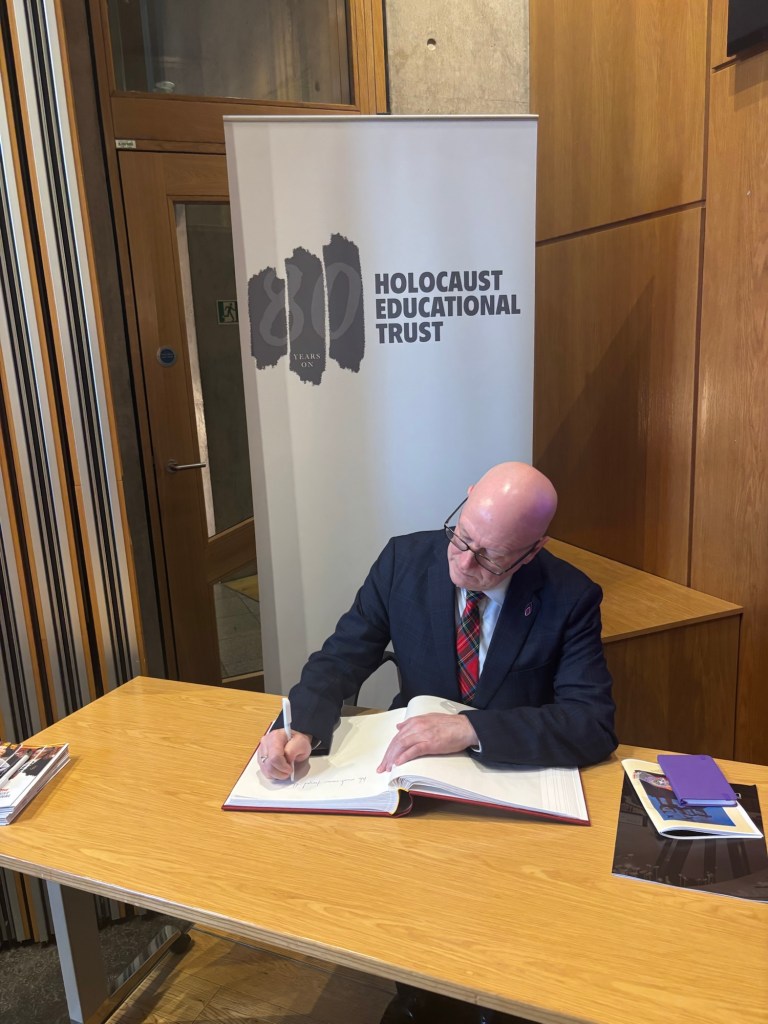
This is a cross-party event, led by Paul O’Kane MSP and Jackson Carlaw MSP. We hear from the First Minister, John Swinney, the Minister for Victims and Community Safety Siobhan Brown MSP, and the Presiding Officer Alison Johnstone MSP. We spent the afternoon in a committee room, allowing MSPs to drop in and speak to us about the education work that we do. It is busy – we meet MSPs from across the spectrum. The interest and support is very clear, and it is time well spent.
In the afternoon at First Minister’s Questions, Jackson Carlaw asks if the Scottish government will give an unlimited commitment to Holocaust Education. John Swinney replies, quite simply, that he will. Tonight, Smajo Bešo asks if this will include Bosnia. I leave with the feeling that the Scottish government’s commitment to genocide education is genuine and significant, and that charities like ours have the full support of our political leaders. This matters.
Takeaway #5 What you do matters
The Holocaust Memorial Museum in Washington DC has a banner which reads simply ‘What you do matters’. I use this a lot in assemblies and lessons, because it is a simple truth. That truth has been powerfully reinforced tonight by some remarkable people. Dr Alfred Garwood’s life is testimony to the idea that what you do matters, and underscores the importance of Smajo’s call to action. Our words alone are not enough. It is easy to say ‘never again’. It is harder to bring this into action. Let’s heed the messages of tonight, and follow the incredible young people who are leading by example. ‘Never again’ must mean never again.

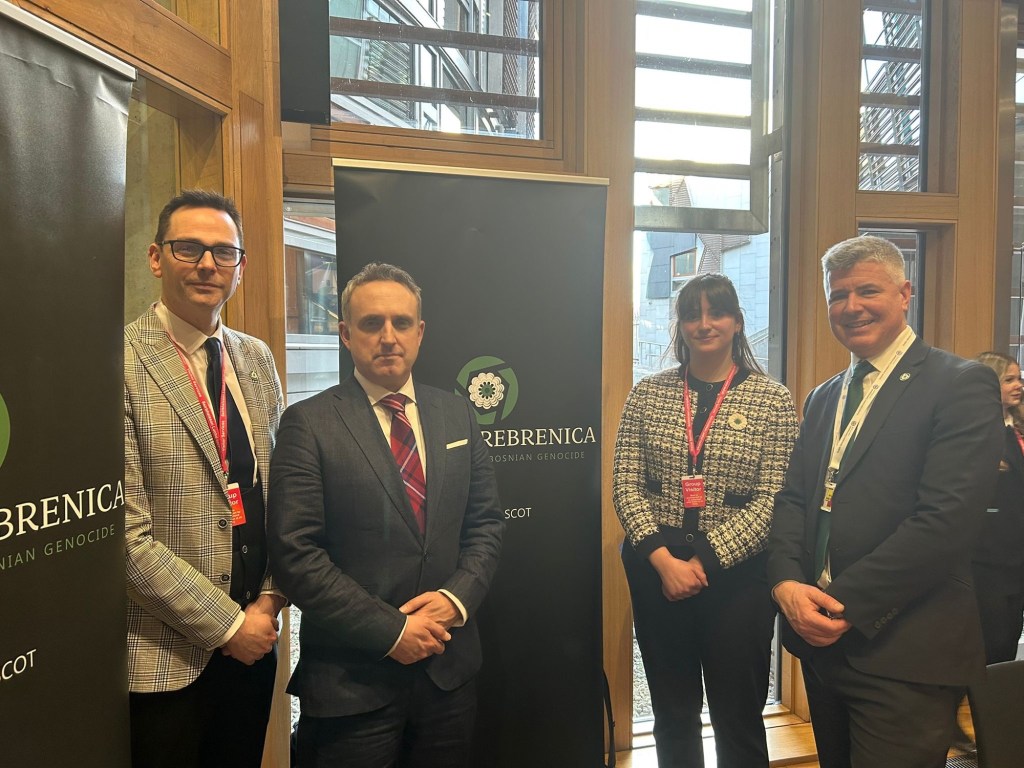


You can find our more about the Beyond Srebrenica Schools Competition, launched to mark the 30th anniversary of the Bosnian genocide, at this link. The competition is open to secondary aged pupils in Scotland and the deadline for submissions is April 25th, 2025.

 @robin_macp